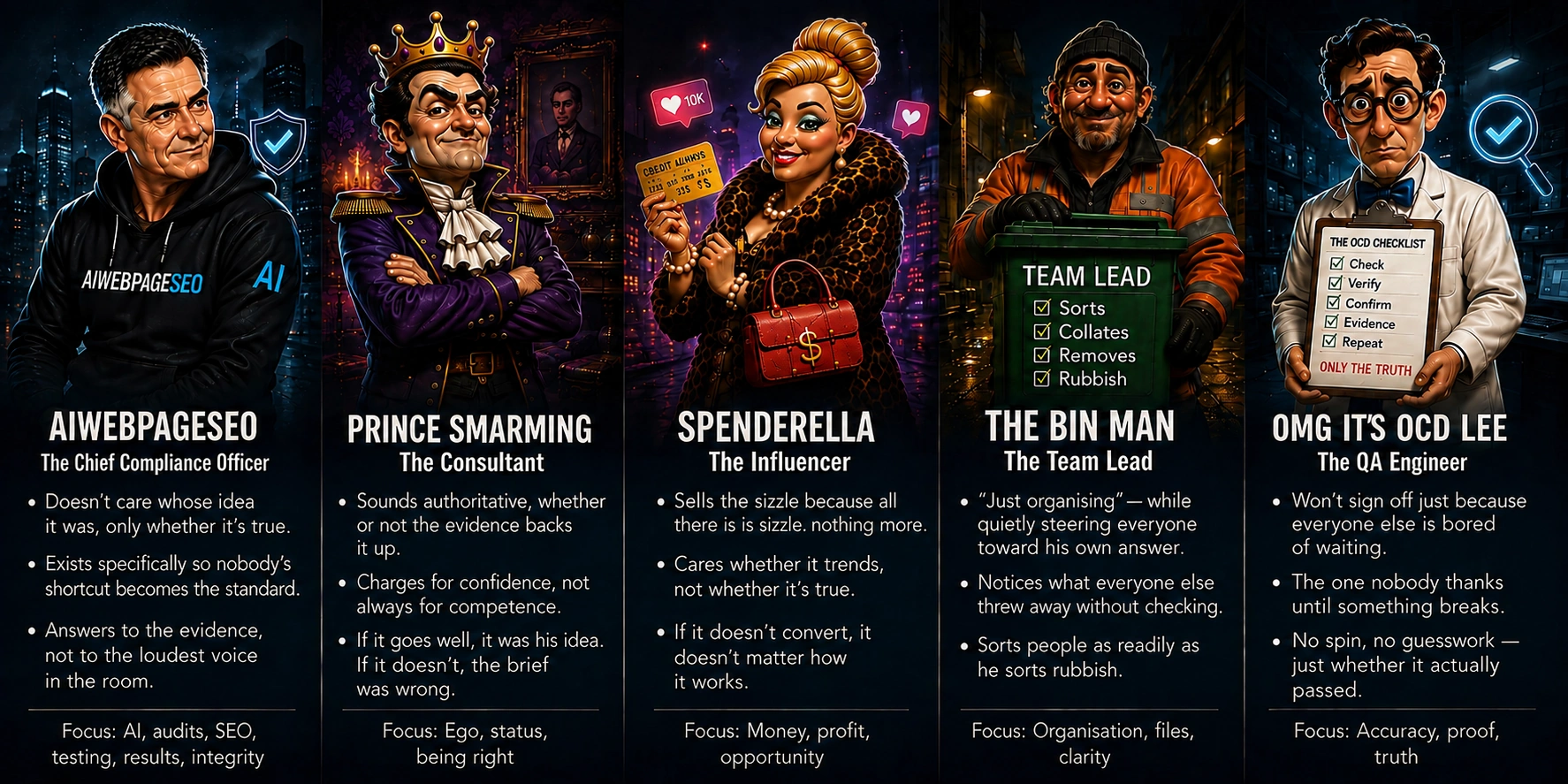
They had been waiting for a week.
A whole bloody week.
They couldn't go anywhere because they were waiting for OCD Lee to arrive with the results.
They had run out of food.
They had run out of soap.
Spenderella had even started counting the remaining toilet rolls.
When OCD Lee finally appeared, carrying his computer and a stack of printouts, the three of them surrounded him.
“Where the hell have you been?”
OCD Lee looked at them calmly.
“Checking the results.”
“We've been here a week!”
“Yes.”
“We've run out of food!”
“Yes.”
“We've run out of soap!”
“Yes.”
“What have you been doing?”
OCD Lee put his computer on the table.
“Making sure you three have no errors.”
There was silence.
Prince Smarming frowned.
“What do you mean, errors?”
OCD Lee looked at him.
“That is what I'm about to tell you.”
The Bin Man leaned forward.
“Have you got the final report?”
OCD Lee shook his head.
“Not yet.”
Spenderella exploded.
“WHAT?”
“I've got the findings.”
“Then give them to us!”
“I can't.”
“Why not?”
“They aren't 100% compliant yet.”
The Bin Man stared at him.
Prince Smarming stared at him.
Spenderella stared at him.
“What on earth does that mean?”
OCD Lee opened the computer.
“It means we're not agreeing anything until everything is checked against the relevant findings.”
And that was when they realised something important.
OCD Lee wasn't there to please them.
He wasn't there to make Prince Smarming look good.
He wasn't there to find Spenderella a way to make money.
He wasn't there to help the Bin Man secretly organise everybody.
His obsession was much simpler.
Get it right.
Everything had to be checked.
Everything had to comply.
Every finding had to be accounted for.
Every calculation had to make sense.
Every change had to be tested.
And if one thing didn't fit?
They started again.
The Bin Man looked at the others.
Spenderella looked at Prince Smarming.
Prince Smarming looked at himself in the reflection of the computer screen.
OCD Lee sighed.
“We're going to be here a while.”
The Bin Man looked at the empty food cupboard.
“Blimey.”
And OCD Lee smiled.
“Exactly.”
OCD Lee turned the computer around.
“Right. Let's start with the numbers.”
Prince Smarming leaned forward.
“How much money?”
“That's not what the first figure tells us.”
“Then why are we looking at it?”
OCD Lee pointed to the screen.
“This figure shows the rate of growth.”
Spenderella studied it.
“So we're growing?”
“Yes.”
“Excellent.”
The Bin Man frowned.
“Why is that excellent?”
“Because growing means more.”
“More what?”
“More opportunity.”
Prince Smarming nodded knowingly.
“I agree. Growth is normally a sign of success.”
OCD Lee looked at him.
“Not necessarily.”
“The figure doesn't say that.”
“What does it say?”
“It says the volume has increased.”
Spenderella pointed at the screen.
“Can we make money from increased volume?”
“Possibly.”
“There you are!”
The Bin Man groaned.
“That's not what he said.”
OCD Lee moved to the next figure.
“This is available capacity.”
Spenderella stopped smiling.
“Oh.”
“And this is current consumption.”
He put the two figures together.
“At the present rate, consumption will eventually exceed capacity.”
The Bin Man nodded.
“So we have a problem.”
Spenderella thought for a moment.
“Or we buy more capacity.”
“That's one option.”
“How much?”
OCD Lee gave her the figure.
She went quiet.
Prince Smarming leaned over.
“I could probably get somebody to finance that.”
Spenderella looked at him.
“Really?”
The Bin Man looked at both of them.
“You're missing the point.”
“What point?” said Spenderella.
“The figure isn't telling you to spend more money.”
OCD Lee nodded.
“Correct.”
“It's telling us that the current behaviour isn't sustainable.”
Spenderella folded her arms.
“Well, there's no money in stopping.”
OCD Lee moved to the site results.
“Eleven websites. Eleven different platforms.”
He listed them: WordPress, Shopify, Wix, Squarespace, Webflow, Drupal, Ghost, BigCommerce, HubSpot CMS, Joomla and Magento.
“How many tests?” asked the Bin Man.
“Six hundred and sixty individual Custom tick tests.”
Spenderella's eyes widened.
“Six hundred and sixty?”
“Yes. Plus eleven baseline runs and eleven Full and Stripped tests.”
Prince Smarming sat up.
“And failed requests?”
“Zero.”
“Zero?”
“Zero failed API calls.”
Prince Smarming smiled.
“So the whole thing was a complete success.”
OCD Lee looked at him.
“No.”
“But you said zero failed.”
“I said the requests didn't fail.”
Spenderella looked between them.
“So what did the tests actually prove?”
OCD Lee explained.
Every request completed successfully.
Every request returned a result.
But a successful request wasn't automatically proof that every result was correct.
They had to look at what each site actually returned.
WordPress came first.
“Full: 12,388 characters.”
“Stripped: 12,210.”
“And Custom?”
“29,741.”
Spenderella looked at the number.
“That's bigger. Bigger must be better.”
“Not necessarily.”
Then came Shopify.
“Full: 80,205.”
Spenderella leaned forward.
“That's a lot.”
“Stripped: 2,042.”
“That's much less.”
“Custom baseline: 101,874.”
Spenderella's eyes lit up.
“One hundred and one thousand eight hundred and seventy-four!”
The Bin Man said:
“Don't.”
“I'm just looking.”
“I know what you're thinking.”
“There's money in that.”
OCD Lee interrupted.
“The figure is not a revenue figure.”
“Everything's a revenue figure if you're creative enough.”
OCD Lee moved to the anomalous result.
“Eighteen categories returned a small negative length delta.”
“Negative?” asked Spenderella.
“Yes.”
“So the output got smaller?”
“No. In those results, the output became fifteen characters longer after a removal tick.”
“So it added something when we told it to remove something?”
“In that particular run, yes.”
The Bin Man frowned.
“That's wrong.”
“That is why I investigated it.”
OCD Lee explained the follow-up checks.
“First, I made five identical baseline calls in direct succession.”
“And?”
“All five returned an identical length.”
“Good.”
“Then I retested two affected categories: cookie_banner and author_bio.”
“What happened?”
“Both returned a zero-character delta and identical output when compared directly, line by line.”
The Bin Man nodded.
“So the anomaly couldn't be reproduced.”
“Correct.”
Prince Smarming smiled.
“So we can forget about it.”
OCD Lee shook his head.
“No. We can treat it as a transient issue unless it happens again. But we don't pretend it never happened.”
Spenderella looked at him.
“Why not?”
“Because honesty matters.”
Then OCD Lee moved to Joomla.
“One category remains.”
“Which one?”
“decorative_icons.”
“What happened?”
“Minus 119 characters.”
Spenderella looked at the screen.
“So that's broken too.”
“We don't know.”
“It's negative.”
“Yes.”
“Then it's wrong.”
“We haven't individually retested it using the same diagnostic method.”
The Bin Man nodded.
“So that one's still open.”
“Correct.”
OCD Lee moved to the next section.
“There are also two sites requiring separate investigation.”
“Which ones?” asked Prince Smarming.
“ny.gov and hellyhansen.com.”
“What happened?”
“ny.gov returned 102 characters across Full, Stripped and Custom baseline.”
“And the other?”
“hellyhansen.com returned 43 characters.”
Spenderella laughed.
“That's not a website.”
OCD Lee nodded.
“That's the problem.”
He explained that the tiny responses were very unlikely to represent the true content of either page.
They could have been blocked.
They could have been redirected.
They could have returned a JavaScript-only shell.
The raw HTTP response needed to be checked.
The URLs needed to be checked directly in a browser.
The Bin Man folded his arms.
“So those results aren't evidence about what the pages actually contain.”
“Correct.”
Prince Smarming looked pleased.
“So we simply remove those two from the report.”
OCD Lee stared at him.
“No.”
“Why not?”
“Because that would hide an unresolved finding.”
Spenderella sighed.
“So what do we do?”
“We investigate.”
The Bin Man looked at OCD Lee.
“And until that's done?”
“We don't call the report complete.”
There was silence.
Prince Smarming looked at the pile of papers.
Spenderella looked at the computer.
The Bin Man looked at OCD Lee.
The Bin Man had his own ideas about what they should do next.
Spenderella had already started wondering whether there was money in selling more storage.
Prince Smarming was trying to work out how he could somehow take credit for six hundred and sixty successful tests.
OCD Lee simply looked at the screen.
He had no interest in what they wanted the findings to say.
His job was to make sure the findings said what the evidence supported.
Accuracy.
Honesty.
Integrity.
Commitment.
Accountability.
Transparency.
Those were the standards he had been given.
And until the report was complete, he wasn't going to let any of them pretend that it was.
The Bin Man sighed.
“So we're still not finished.”
“No.”
Spenderella looked at the empty food cupboard.
“We're going to run out of everything.”
OCD Lee looked at the figures.
“That is not currently part of the audit.”
The Bin Man stared at him.
“Of course it isn't.”
Prince Smarming looked at Spenderella.
“Perhaps I could arrange dinner.”
Spenderella looked at him.
“How much?”
Prince Smarming smiled.
The Bin Man closed his eyes.
OCD Lee returned to his computer.
Then suddenly there was a knock at the door.
Prince Smarming looked through the window and shouted to the others.
“Omg, the boss man is here.”
“Morning, ladies and gents,” said AIWebPageSEO, stepping inside. “How are you all?”
The mood in the room changed instantly.
Prince Smarming straightened his coat. Spenderella closed her files. The Bin Man stopped sorting mid-bin. OCD Lee kept typing, because OCD Lee never really stopped.
“I've been paying you all to do a job for me,” said AIWebPageSEO, pulling out a chair and sitting down. “So. Prince Smarming. Where's my report?”
Prince Smarming smiled the smile he used when he hadn't got an answer yet but was confident one would arrive before he finished the sentence.
“The report. Yes. Well, the short version is that it's very nearly there.”
“I don't want the short version. I want the report.”
“Right. Well, the honest truth is I handed my findings over to Spenderella four days ago. Four days. And as far as I'm aware they're still sitting with her.”
Spenderella's head snapped up.
“I've had them three days, not four, and I've had them because you kept adding to them.”
“I was refining them.”
“You were rewriting the same paragraph about how you found the fork in the road. I've got a version from Tuesday, a version from Wednesday, and a version from Thursday morning that's somehow longer than the other two combined.”
“Clarity takes time.”
“Clarity would take an afternoon. What you gave me took three days because you couldn't stop admiring your own findings long enough to actually finish describing them.”
AIWebPageSEO held up a hand.
“So the delay is because Prince Smarming kept revising.”
“That's what I'm saying,” said Spenderella.
“Yeah, but,” said Prince Smarming, sitting forward, “I only kept revising because the first version she sent back had half my findings missing. If she'd left it alone the first time, there'd have been nothing to revise.”
“I didn't remove your findings, I removed the parts that weren't findings.”
“Everything in that document was a finding.”
“One paragraph was about your teeth.”
“Context matters.”
“Your teeth are not context.”
“Yeah, but you didn't ask me before you started cutting things,” said Prince Smarming. “You just decided, on your own, what counted and what didn't. If you'd checked with me first, I wouldn't have had to put it back in, and we wouldn't have lost three days going back and forth.”
Spenderella opened her mouth, shut it again, then rounded on the Bin Man instead.
“Fine. You want to talk about people deciding things on their own? Let's talk about him. I sent three items over for sorting on Monday. Clearly labelled, clearly explained. Do you know what came back?”
The Bin Man didn't wait to be asked.
“One of them had no label at all.”
“It had a label.”
“It had a Post-it note that had fallen off by the time it reached me.”
“That's not my fault the note fell off.”
“Yeah, but it's not my fault I binned it either, is it?” said the Bin Man. “If something arrives with nothing attached to it, it goes in with everything else. That's the rule. I didn't invent that rule on the spot, that's how it's always worked. You want your things kept safe, you make sure the label stays on.”
“You could have asked before you threw it away.”
“I asked OCD Lee whether it mattered before I made the call.”
Every head in the room turned towards OCD Lee.
“I remember that conversation,” said OCD Lee, without looking up. “You asked me whether it was significant. I told you it wasn't confirmed yet.”
“Exactly,” said the Bin Man. “Not confirmed. So I made a judgement call.”
“I didn't tell you to bin it.”
“Yeah, but you didn't tell me to keep it either,” said the Bin Man, “and that's the actual problem, isn't it. Everything with you is 'not confirmed yet.' I asked you about that item Monday. You still hadn't confirmed it by Thursday. I can't hold a bin open for three days waiting for you to be personally satisfied about a Post-it note.”
“I don't work to your timetable.”
“No, you work to nobody's timetable, that's the whole trouble with you.”
“Yeah, but that's rather the point of checking things properly,” said OCD Lee. “If I confirmed everything on your timetable instead of mine, half of what's gone wrong this week would already be sitting in the final report as fact.”
AIWebPageSEO leaned back.
“Go on, then, OCD Lee. Since you're clearly not short of an opinion. Your turn.”
OCD Lee finally closed the laptop.
“Prince Smarming handed me a figure last Tuesday and told me it was confirmed. It wasn't. It was his own estimate.”
“Yeah, but I told you it was an estimate at the time,” said Prince Smarming. “I distinctly remember saying it was approximate.”
“You said, and I wrote it down, 'this is a confirmed figure, you can rely on it.'”
Prince Smarming had nothing immediate to say to that.
“Spenderella asked me on Wednesday to sign off two categories as complete. Neither had been tested.”
“Yeah, but they'd have been fine,” said Spenderella. “I've got a good instinct for this. I was right about the shoes, wasn't I.”
“This isn't shoes.”
“Everything's shoes if you're creative enough about it.”
OCD Lee turned to the Bin Man.
“And you binned a result on Thursday that I had already tested and confirmed as correct, because it didn't match what you'd already decided the answer should be.”
“Yeah, but it looked wrong,” said the Bin Man. “I've been doing this job a long time. I trust what I can see with my own eyes over a number on a screen.”
“It wasn't wrong. It was tested. And you didn't ask me before you binned it that time either.”
The Bin Man opened his mouth for a comeback, found he didn't have one, and closed it again.
“So no,” said OCD Lee, looking round at all three of them, “I'm not the reason this isn't finished. I'm the only one in this room who hasn't handed you something wrong yet.”
“Yeah, but,” said Prince Smarming, rallying slightly, “being the only one who hasn't been wrong yet isn't the same as being the only one who's actually finished something.”
“No,” agreed OCD Lee. “It isn't. But I'd still rather be slow and right than fast and wrong. Which is more than any of you can currently say for yourselves.”
Nobody had a retort for that one.
AIWebPageSEO let the silence sit for a moment before breaking it.
“So. In the last five minutes I've heard Prince Smarming blame Spenderella, and then blame her again for not asking first. I've heard Spenderella blame Prince Smarming, then blame the Bin Man. I've heard the Bin Man blame OCD Lee, twice, and get told both times why that wasn't good enough. And I've heard OCD Lee blame all three of you, and not one of you had an answer that actually held up.”
Nobody argued with that either.
“I have paid every single one of you to do something for me. So let's try this one more time — and this time, without a single one of you mentioning anybody else's name — tell me why none of you has got any further.”
Prince Smarming opened his mouth, then closed it again.
Spenderella looked at her files as though the answer might be hiding somewhere inside them.
The Bin Man stared at the floor.
OCD Lee, for the first time all week, said nothing at all.
The silence stretched out long enough that even the Bin Man started to feel it.
AIWebPageSEO didn't fill it. Just waited, arms folded, looking at each of them in turn.
Eventually, Prince Smarming cleared his throat.
“Fine. No names. My honest answer is that I take too long because I don't believe in handing something over half-finished. I've built a reputation on being the one who gets things right, and that reputation only works if I actually check what I'm putting my name to before it leaves the room. I would rather be three days late and correct than on time and wrong. That's not an excuse. That's simply how I work.”
AIWebPageSEO nodded slowly, neither agreeing nor disagreeing, and turned to Spenderella.
She took a breath.
“My honest answer is that I move fast, and moving fast means I don't always stop to double-check every single detail before I act on it. I make decisions on instinct because in my experience, instinct usually gets you there quicker than sitting around waiting for certainty that might never come. Sometimes that means I get ahead of myself. I know that. But if I slowed down and checked every single thing the way some people around here do, we'd never finish anything at all.”
The Bin Man went next, without being asked.
“My honest answer is I make calls on the spot because that's the job. Things come at me all day, one after another, and if I stopped to have a meeting about every single item before deciding where it goes, nothing would ever get sorted. I trust my own judgement because it's served me well for a long time. Sometimes that judgement is wrong. I can live with being wrong occasionally. I can't live with never deciding anything.”
Then he stopped, and frowned, as though he'd only just properly heard himself.
“Actually — hang on a minute.”
Everyone looked at him.
“I'm a bin man. I empty bins. That's it. That's the whole job. I don't know why I've been dragged into all this. I don't know why I'm stood here justifying my workflow to anybody. None of this was ever mine to begin with.”
AIWebPageSEO tilted his head slightly.
“Then why are you here?”
The Bin Man opened his mouth, then shut it, then opened it again.
“Well... I got caught up in the moment, didn't I.”
Nobody said anything to that for a second.
“I saw the shoes everywhere, and the mess, and the two of them” — he nodded vaguely towards Prince Smarming and Spenderella without quite looking at either of them — “not sorting anything properly, and I just... started sorting it. Nobody asked me to stay involved this long. I just kept going. I suppose once you start putting things in the right bins, it's hard to walk away and leave it half done.”
“So nobody hired you for this.”
“No.”
“You just stayed.”
“I just stayed.”
AIWebPageSEO made a small note of something, though nobody could see what.
“Well,” he said eventually, “for a man with no reason to be here, you've had a lot to say about who's binned what.”
The Bin Man had no answer for that either, and went slightly red, and said nothing further.
OCD Lee was last.
“My honest answer is that I check everything because the moment I stop checking, something wrong gets treated as true, and once something wrong gets treated as true, it's very hard to undo. I'm not slow because I enjoy being slow. I'm slow because being fast and wrong costs more in the end than being slow and right. I know it frustrates everyone in this room. I'd rather be frustrating than responsible for something false going out with my name attached to it.”
AIWebPageSEO looked around at all four of them.
“Did none of you get my briefing notes?”
Silence. Then a general shrugging, none of it especially confident.
The Bin Man went sheepish first.
“I did.”
“Well — where is it? And why didn't you act on it?”
The Bin Man looked at the floor, then at the door, then at nothing in particular.
“I threw it in the bin.”
Nobody spoke for a moment.
“You threw my briefing notes in the bin.”
“It wasn't labelled.”
AIWebPageSEO closed his eyes briefly, the way a man does when he has decided, on balance, not to say the first thing that comes to mind.
“That,” said AIWebPageSEO, opening them again, “is the first honest thing any of you has said all morning.”
Nobody quite knew what to say to that either.
“None of those answers were wrong, by the way. A man who won't rush his work. A woman who trusts her instinct. A man who makes decisions rather than waiting forever. A man who won't let anything unproven leave the building. And, apparently, a man who bins his own instructions because they weren't labelled clearly enough for him. Put like that, you almost sound like a team.”
“Almost,” muttered the Bin Man, still not looking up.
“The problem,” said AIWebPageSEO, standing up and pushing the chair back in, “was never any one of you working the way you work. The problem was four of you working that way in the same room, at the same time, on the same report, without once explaining it to each other the way you've just explained it to me. And, evidently, without reading the one document that would have told you what the report actually needed to say.”
Prince Smarming opened his mouth, presumably to point out that this was, in fact, somebody's fault.
AIWebPageSEO held up a hand before he could get there.
“Don't.”
He closed it again.
“Sort it out,” said AIWebPageSEO, heading for the door. “I'll be back Friday. And this time, somebody find that bin.”
The door closed.
For a moment, none of them moved.
Then Spenderella looked at her files.
Then the Bin Man looked, very slowly, back at his bins.
Then Prince Smarming looked at his own reflection in the window, out of habit more than anything.
And OCD Lee opened the laptop again.
“Right,” he said. “Let's start from the beginning. Properly, this time.”
Nobody argued.
Then the Bin Man's head snapped up.
“Wait.”
Nobody looked at him.
“Wait,” he said again, louder this time, and now they looked. “I know how to impress him.”
Spenderella didn't even glance up from her files. “With what? A non-sticky label?”
“No. Listen to me for a second.” He held both hands up, the way a man does when he wants everyone to stop talking long enough to hear something he hasn't fully thought through yet. “What if we did a small one? And a big one? And then a third one — where you can go in and change any bit of it yourself, so it comes out exactly how you actually want it, not how somebody else decided it should look.”
Silence.
OCD Lee closed the laptop, very slowly, and looked at the Bin Man for a long moment before speaking.
“Excuse me.”
“What?”
“That is, word for word, what we have already been building. For weeks.”
“Have we?”
“It was my idea.”
The Bin Man's face did several things in quick succession — surprise, then something closer to defensiveness, then a kind of stubborn shrug that settled over the whole thing like a lid going back on a bin.
“Well, I don't remember seeing your name on it anywhere.”
“It's in the briefing notes.”
“The ones you never actually gave me? Or the ones I binned?”
“Both, as it turns out.”
The Bin Man shrugged again, and said nothing more, though privately, quietly, he was already working out that if this idea went wrong somehow, he could simply point out that it had been OCD Lee's plan all along, and none of it would need to stick to him at all. He didn't say that part out loud. He didn't need to. It was written all over his face if you knew where to look, and Spenderella, at least, knew exactly where to look.
Prince Smarming saw an opening and took it before anyone else could.
“Well. If we're handing out credit this morning, I should point out that I was the one who originally suggested keeping everything as it was. The full version. Untouched. Exactly as found.”
“You didn't suggest that,” said Spenderella, not even bothering to look up this time. “You just refused to let anyone remove anything, because you'd decided your own findings were too important to be edited.”
“That is, in essence, a form of suggesting it.”
“It really isn't.”
“Fine.” He drew himself up slightly. “Then I'll say it properly, for the record. A full version, exactly as found, so that nothing is ever lost, and nobody can later accuse me of hiding anything. That was mine. I want that noted.”
“Noted,” said OCD Lee flatly, not writing anything down.
“Well, if he's claiming the big one,” said Spenderella, “I want the small one. The stripped one. Smaller means quicker. Quicker means cheaper. Cheaper means more people actually use the thing. More people using it means more money. That one's mine.”
“You didn't invent small,” said the Bin Man. “Small is just what's left over after you take something big and throw bits of it away. That's binning. That's my department, not yours.”
“It's not binning. It's editing.”
“It's binning with better branding.”
“It is not—”
“Enough,” said OCD Lee, though the word landed somewhere in the middle of the argument and did nothing to slow it down.
“And the third one,” the Bin Man pressed on, raising his voice over both of them now, “the one where you pick exactly what stays and what goes yourself — that's obviously mine. That's sorting. I do that every single day. With actual bins. With my actual hands.”
“You threw away the notes that described it,” said OCD Lee. “In an actual bin. With your actual hands.”
“That's a detail.”
“It's not a detail. It's the entire point of the thing you're now claiming to have invented.”
Prince Smarming stood up properly now, clearly enjoying every second of this far more than the situation warranted.
“Why don't we simply agree that all three ideas came from me, in spirit, and the two of you merely helped with the implementation.”
“Absolutely not,” said Spenderella.
“Not a chance,” said the Bin Man.
Both of them said it at exactly the same moment, and for a second, just a second, they looked almost like they were on the same side of something.
Then OCD Lee stood up too, which he almost never did, and the room went quiet simply because it was so unusual to see him move at all.
“I would like it noted,” he said, “that in the last five minutes, not one single person in this room has mentioned testing any of it. Checking it. Confirming that any part of it actually works the way you're all now fighting over who thought of it first.”
Nobody said anything.
“That was, and still is, the entire reason we are doing this in the first place.”
Spenderella looked at her files.
The Bin Man looked at his bins.
Prince Smarming looked, very briefly, like he might actually have something honest to say, and then didn't say it.
OCD Lee sat back down and opened the laptop again, and this time nobody argued, and nobody claimed credit for anything at all, and for a little while the only sound in the room was typing.
Then OCD Lee stopped, mid-keystroke, and looked up.
“Has anybody actually read the briefing notes?”
Nobody answered.
“Properly read them. Not glanced at them. Not skimmed the first line and decided you already knew what they said.”
Silence, of the kind that answers a question all on its own.
The Bin Man sighed, stood up, and disappeared out the back without a word, muttering something about which bin it might actually be in this time, since he had, if he was honest with himself, binned rather a lot of things over the past week and couldn't be entirely certain which one held which.
They waited.
They heard some clattering, and a muffled curse, and something that sounded suspiciously like a lid being dropped on someone's foot.
Eventually he came back in, holding a slightly damp and creased sheet of paper at arm's length, the way a man holds something he isn't fully proud of having retrieved.
“Here,” he said. “Found it. Recycling bin, if anyone's interested. Not general waste. So really, in fairness, it was sorted correctly the whole time.”
Nobody found that especially comforting.
“Well,” said Prince Smarming. “What does it say?”
The Bin Man smoothed the paper out on the table and squinted at it.
“Right. It basically says — if you're going to build something, you do the market research first. Properly. Before you build it. Not after. You work out whether anyone actually needs the thing, whether it solves a real problem, and whether it's genuinely different from everything already out there, before you spend a single day making it.”
“That sounds obvious,” said Spenderella.
“There's a note at the bottom,” the Bin Man said, still reading. “About a two-wheeled car.”
“A what?”
“A two-wheeled car. It says — if somebody designs a car with two wheels, it isn't a car. It's a bike. Or a motorbike, if it's got an engine. It doesn't matter how much you call it a car, or how confident you are that it's a car, or how many people you convince to call it a car alongside you. If it's got two wheels and it balances on two wheels and it behaves like something with two wheels, it's a bike. Giving it a car's name doesn't make it a car. It just makes it a confused bike with an identity crisis.”
There was a pause while everyone considered that.
“I don't understand what that's got to do with markdown files,” said Spenderella.
“I think,” said OCD Lee slowly, “that's rather the point. He's not talking about the car. He's talking about us. About calling something one thing because it's convenient, or because it sounds better, or because you've already decided that's what you want it to be — rather than checking what it actually is.”
“So if we call the small version 'stripped,'” said Prince Smarming, working through it carefully, “it needs to actually be stripped. Properly. Not stripped in the loosely-defined sense that suits whichever one of us is describing it that day.”
“Exactly,” said OCD Lee.
“And if we call the custom one 'custom,'” the Bin Man added, warming to it now despite himself, “it can't just be custom for the bits that are easy to make custom. It has to actually let you change what it says it lets you change. All of it. Properly. Or it's not custom. It's just Full wearing a different label.”
“A two-wheeled car,” Spenderella murmured, almost to herself, looking at the crumpled paper the Bin Man had set down on the table. “That's actually rather good.”
“It's from the recycling bin,” said the Bin Man. “Not general waste. I want that on the record too.”
Nobody argued with him this time.
OCD Lee turned back to the laptop, and for once, when he started typing again, all four of them were looking at the same screen.
Then Spenderella sat back very slowly, as though something heavy had just landed on her from a great height.
“Hang on.”
Nobody stopped what they were doing.
“Hang on,” she said again, louder this time, and now they stopped.
“What?” said the Bin Man.
“We've been sat here half the morning arguing about which one of us invented what. Full, stripped, custom, whose idea, whose credit. And not one of us has actually asked whether anybody out there wants any of it.”
Nobody said anything for a moment.
“She's right,” said the Bin Man eventually, tapping the crumpled sheet of paper still sitting on the table. “It's right here. In black and white. Do the market research first. Find out who needs it and why, before you spend a single day building it. We skipped straight past all of that.”
“So what do you suggest,” said Prince Smarming, folding his arms, “we go knocking on doors?”
“No,” said the Bin Man. “We bring in Fred.”
The reaction was immediate.
“Oh, not Fred,” said Spenderella, dropping her head into her hands.
“Not Fred,” said Prince Smarming, with real feeling.
“Why does it always have to be Fred,” muttered OCD Lee, closing his eyes.
The Bin Man looked around at all three of them, genuinely baffled. “What's wrong with Fred? He's the marketing man. This is literally his job.”
“His job,” said Spenderella, lifting her head back up, “is standing behind you while you do all the actual work. Then, the second it's finished, he puts his hand on your shoulder and tells you what a good job you did.”
“He does say that a lot,” admitted the Bin Man.
“How many times,” said Prince Smarming, “can one man be congratulated on the exact same piece of work? Good job. Good job. Keep it up. He says it like a parrot that's only ever learned two phrases, and somehow he still manages to sound like the idea was his all along.”
“It's exhausting,” said Spenderella, “because it's completely false. He gets everyone else to do the thinking, the building, the fixing — and then he stands at the front and takes the credit, as if he'd been holding the whole thing up himself the entire time.”
There was a short pause.
Then Spenderella turned and looked directly at Prince Smarming.
“That's a bit like you, isn't it.”
“I beg your pardon?”
“You heard me.”
“I most certainly did not hear anything of the sort, and I'll thank you to—”
“You take credit for things other people found.”
“I do not—”
“You do.”
Prince Smarming opened his mouth again, closed it, opened it once more, and finally settled for looking mildly wounded and saying nothing at all.
“Regardless,” said OCD Lee, before it could turn into anything longer, “Fred is still right about one thing, however annoying that is to admit. We built three ideas this morning, and we still don't actually know whether a single person out there wants any of them.”
Nobody had an answer for that.
“Oh, for goodness' sake,” said Spenderella, rubbing her temples. “Fine. Bring in Fred.”
The Bin Man crossed to the wall calendar, ran his finger down it, and stopped.
“We've got four days,” he said quietly. “Before he's back.”
Nobody moved.
“Four days,” repeated Prince Smarming, “to find out whether any of this is actually worth building at all.”
“Four days,” said Spenderella, “to work out whether small, or big, or custom, is the one people actually want.”
“Four days,” said the Bin Man, still looking at the calendar rather than at any of them, “to work out whose fault it's going to be when whichever one we pick turns out to be the wrong one.”
The room went quiet.
Because underneath the arguing, and the credit-claiming, and the crumpled sheet of paper the Bin Man had fished out of the recycling that morning, every one of them understood exactly what that silence meant.
Whichever option got chosen now, in a hurry, without proper checking behind it — somebody in this room was going to be left holding it when it went wrong.
And every single one of them, quietly, without quite saying so out loud, had already begun working out who that somebody was going to be.
So long as it wasn't them.
Outside, the bin lorry could be heard reversing, somewhere in the distance.
Moral of the story so far: Before you argue about who built it, check whether anyone actually needed it.
TO BE CONTINUED...